Best VPN for Streaming 2026 - Netflix, Disney+, Hulu & Daily Speed Tests
Last updated: August 5, 2026 - VPN Universe
If you want a VPN mainly for streaming, the question is not just “which VPN is fastest?” A good streaming VPN needs stable speeds, working apps, reliable server switching, and enough consistency for Netflix, Disney+, Hulu, Max, Prime Video, YouTube TV, ESPN+, and other services that frequently block shared VPN IPs.
This page is a focused streaming add-on to the main VPN Universe comparison. It uses the same VPN group, affiliate deals, daily speed chart, and streaming connection charts already tracked by this project.
Update: the main streaming comparison is now also included directly on the VPN Universe homepage for easier navigation. Start with Best VPN for Streaming on GitHub, then use this page as the longer supporting guide.
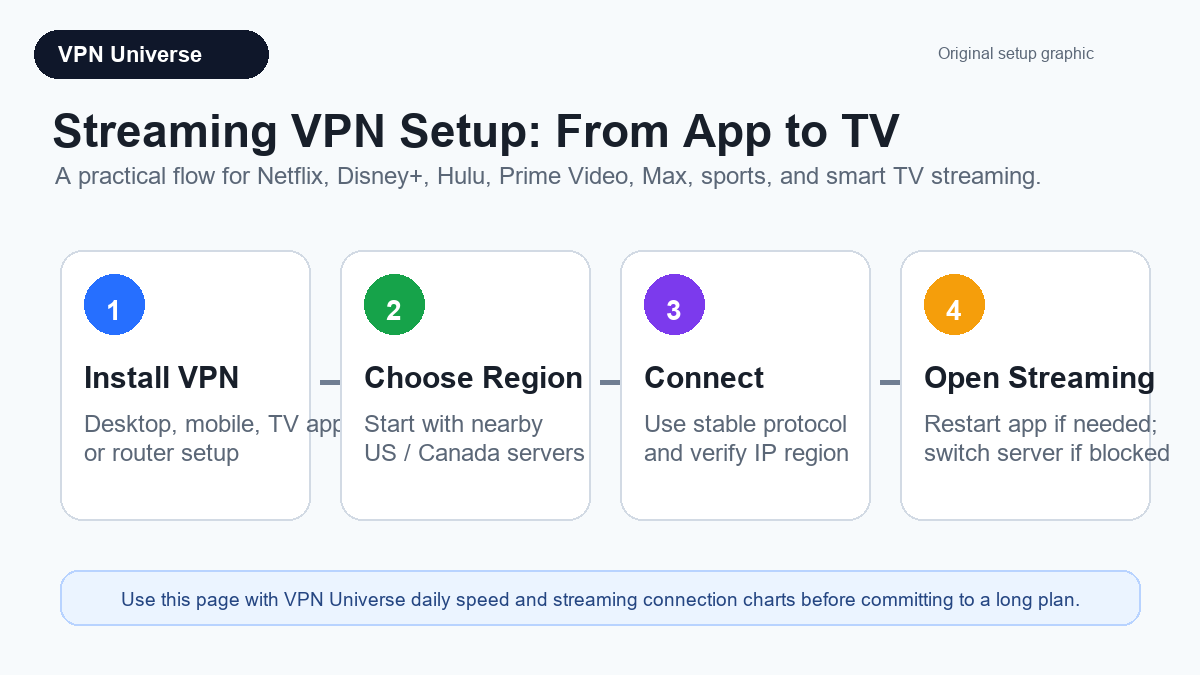
Quick Picks for Streaming
| Best For | Pick | Why |
|---|---|---|
| Best premium streaming stability | ExpressVPN | Best fit if you want fewer server changes, polished apps, and strong 4K streaming reliability. |
| Best value streaming VPN | StrongVPN | Good value if you want a paid VPN for regular streaming without premium pricing. |
| Best for households | Surfshark | Unlimited devices make it practical for families, shared apartments, and multiple TVs. |
| Best short trial | FlowVPN | Useful if you want to test a VPN before paying for a longer plan. |
Disney+ First: What to Click If This Is Your Main Problem
If your real problem is Disney+, do not buy a VPN only because a review says “fastest VPN.” Disney+ failures usually look like one of these: the app opens but playback fails, the catalog changes after login, a server works in the browser but not on Fire TV, or the VPN IP gets blocked after a few sessions.
For a normal US or Canada streaming test, the most practical first move is StrongVPN for Disney+ testing. It is the value pick on this page: cheaper than premium-first options for a one-year plan, simple enough for daily use, and worth testing during the refund window before you pay more for a brand-name VPN.
Choose ExpressVPN if you care more about premium app polish, support, and paying extra for fewer manual fixes. Choose Surfshark if your household needs many devices at once. Use FlowVPN only when you want a short trial before committing.
| Disney+ Situation | Best First Move | Why |
|---|---|---|
| You want one paid VPN mainly for Disney+ and everyday browsing | StrongVPN | Best value-first click: test Disney+, Netflix, Hulu, and public Wi-Fi without premium pricing. |
| Disney+ is mission-critical and you want the smoothest premium app | ExpressVPN | Better if you are willing to pay more for app polish, support, and broad streaming guidance. |
| Multiple TVs, tablets, phones, and laptops need streaming coverage | Surfshark | Unlimited devices can matter more than single-device speed for families. |
| You are not sure Disney+ will work on your exact network | FlowVPN | Short trial mindset: test first, then decide whether to buy a longer plan. |
Quick Disney+ test plan: install the VPN, connect to a nearby US or Canada server, open Disney+ in a fresh browser first, then test the app on your real device. If playback fails, clear app cache, switch to another nearby server, and test again before the refund window ends.
Streaming Platform Cheat Sheet
| Service | Common VPN Problem | What to Try First | Best Starting Pick |
|---|---|---|---|
| Netflix | Proxy error, wrong regional library, video stuck at lower quality | Clear cookies, switch to another nearby server, restart the app | ExpressVPN |
| Disney+ | Login works but playback fails, catalog mismatch, VPN IP blocked | Change US/Canada server, test browser and app separately | StrongVPN as the value test; ExpressVPN if you want premium support |
| Hulu | Location error, live TV region mismatch, app cache problem | Use US servers only, clear app storage, reconnect | ExpressVPN |
| Max / Prime Video | App detects VPN or shows local catalog | Try another server in the same country before switching regions | Surfshark |
| ESPN+ / YouTube TV | Sports blackout, local market mismatch, location check | Use the target region consistently and avoid changing locations mid-session | StrongVPN |
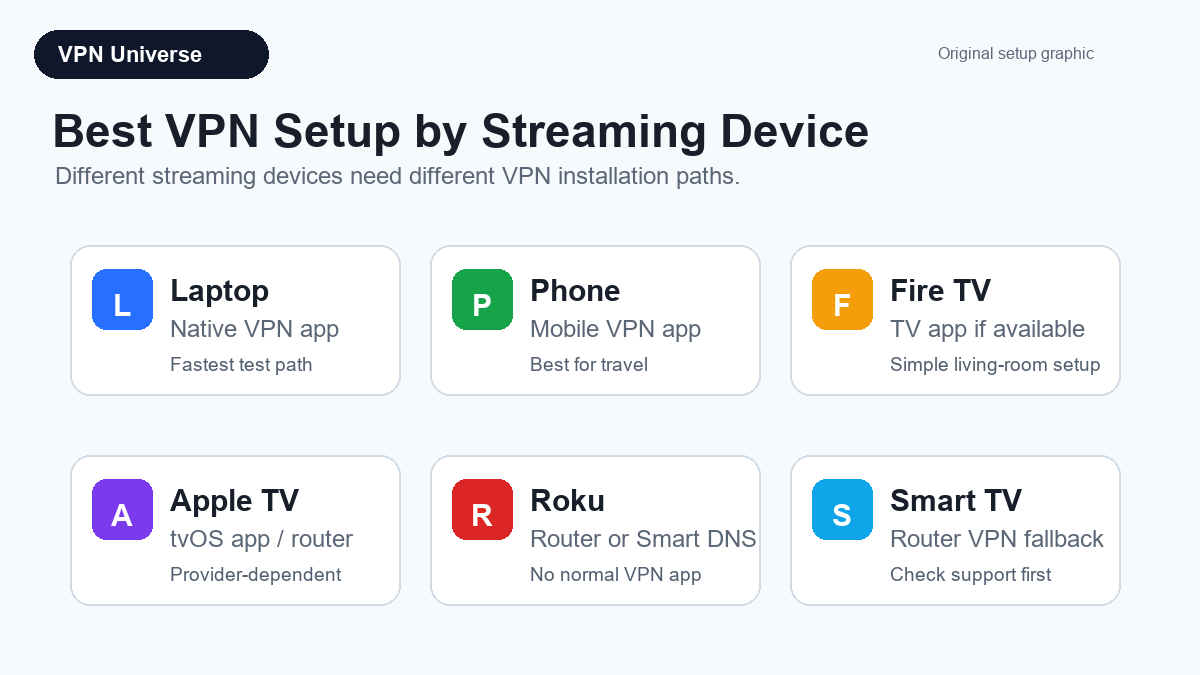
Best VPN by Streaming Device
| Device | Best Setup Method | Practical Notes |
|---|---|---|
| Windows / macOS laptop | Native VPN app | Easiest way to test Netflix, Hulu, Disney+, and Prime Video quickly. |
| iPhone / Android | Native mobile app | Good for travel and hotel Wi-Fi; restart the streaming app after changing VPN servers. |
| Fire TV / Fire Stick | Install VPN app from the Amazon Appstore when available | Prefer providers with a real Fire TV app. If the app is not available, router setup may be required. |
| Apple TV | Native tvOS app if available, or router/Smart DNS setup | tvOS support is improving, but older Apple TV setups may still require router-level configuration. |
| Roku / Chromecast / game consoles | Router VPN or Smart DNS | These devices usually do not support normal VPN apps directly. |
| Smart TV | Native app if supported, otherwise router VPN | Check support before buying; many Smart TVs cannot install standard VPN apps. |
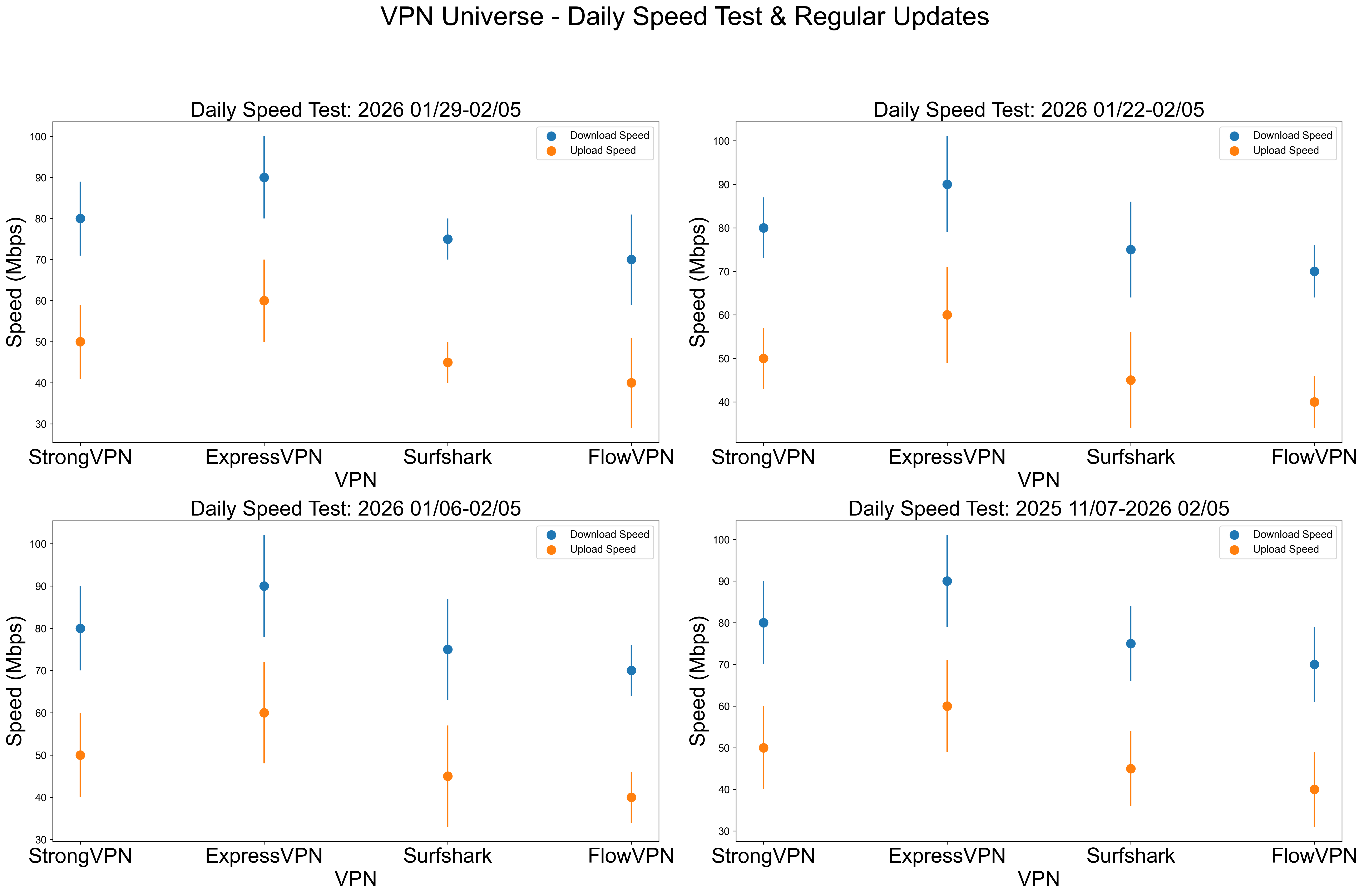
Daily Streaming VPN Speed Chart
For streaming, raw peak speed is less important than consistency. HD video normally needs far less bandwidth than a speed test number suggests, but unstable VPN routes can still cause buffering, login errors, and repeated server switching.
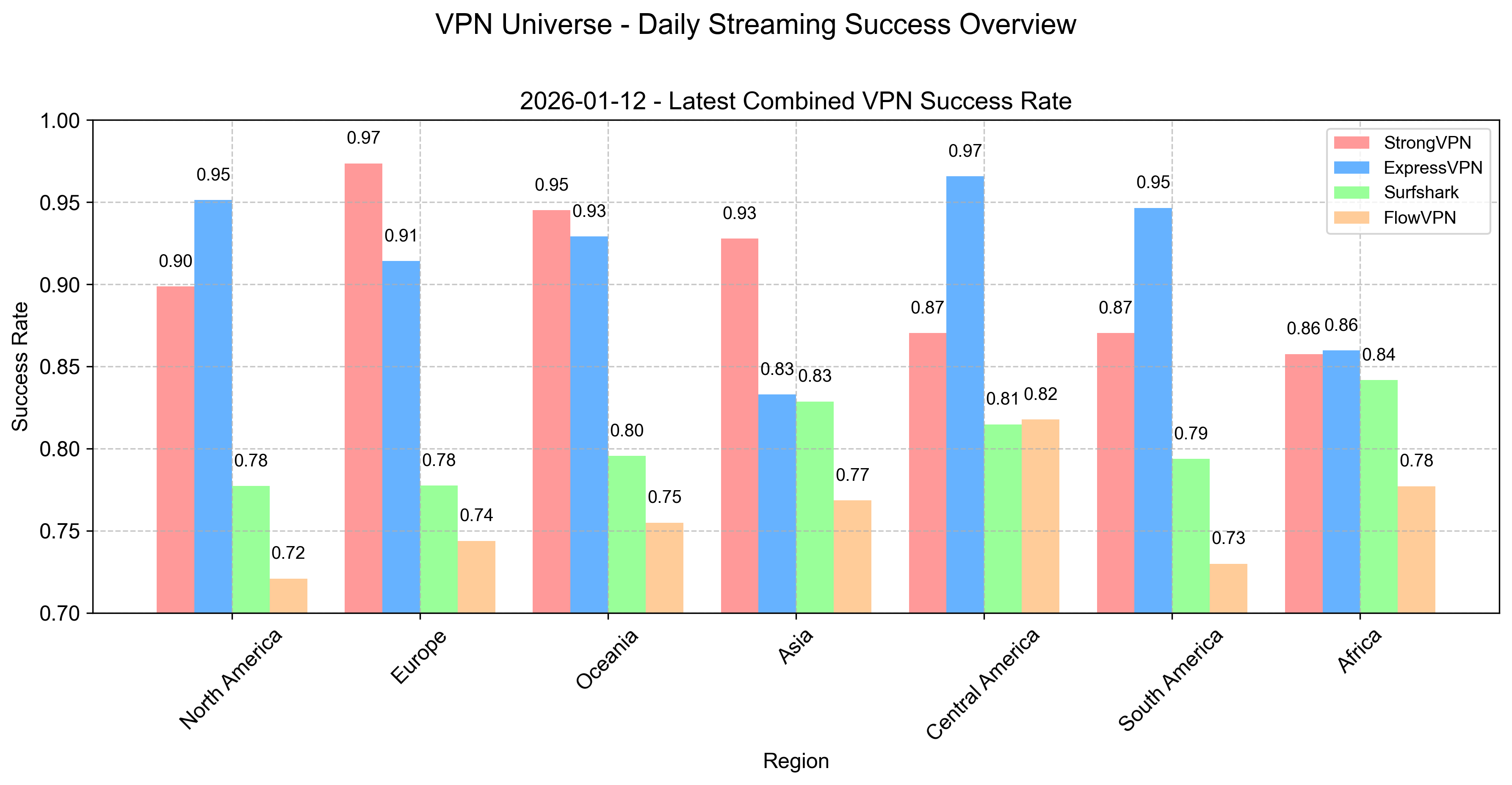
Overall Streaming Connection Chart
This combined chart gives a quick view of connection success patterns across the VPNs tracked by VPN Universe. Use it as a directional signal, then verify with your own target platform before committing to a long plan.
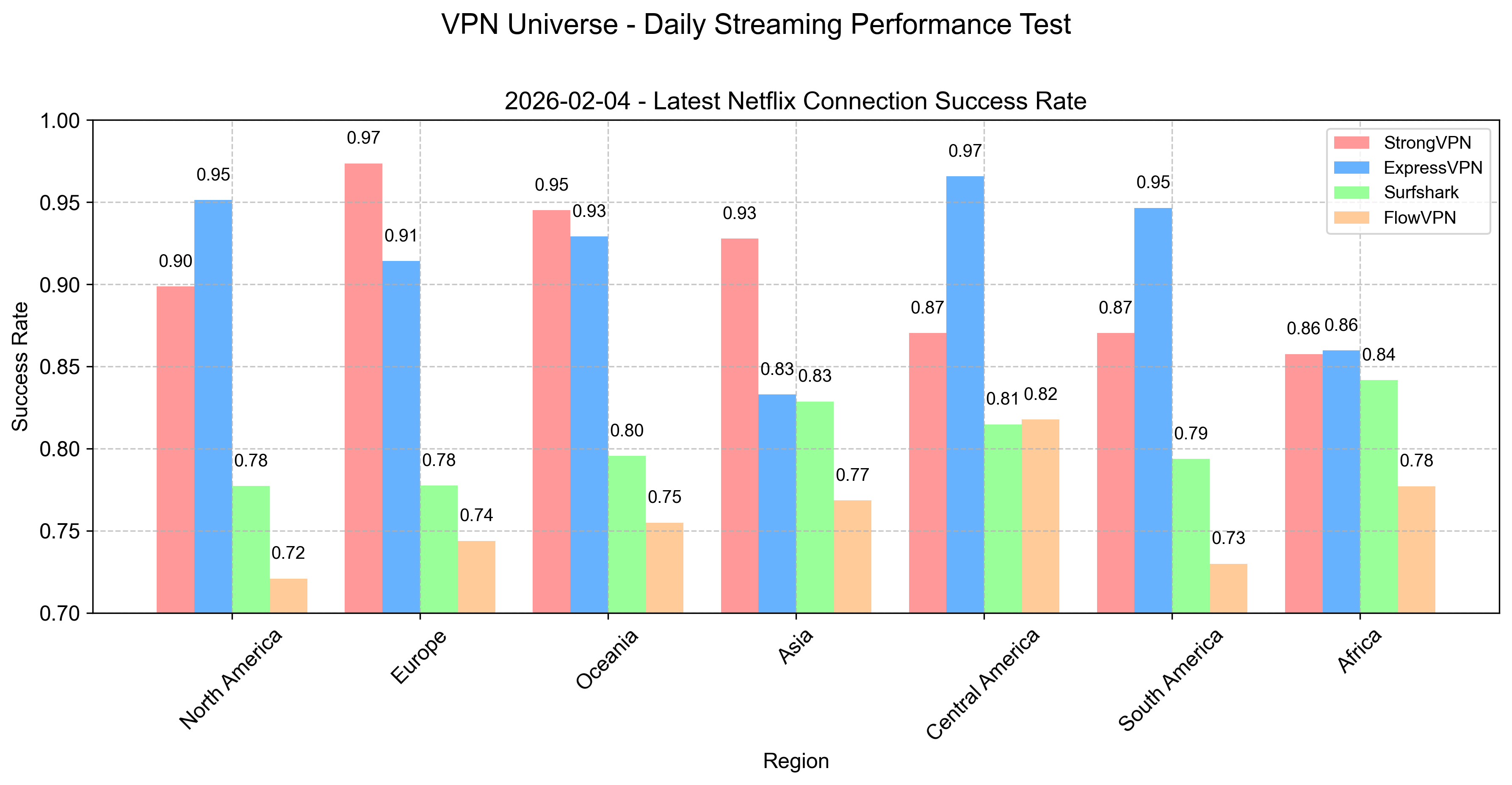
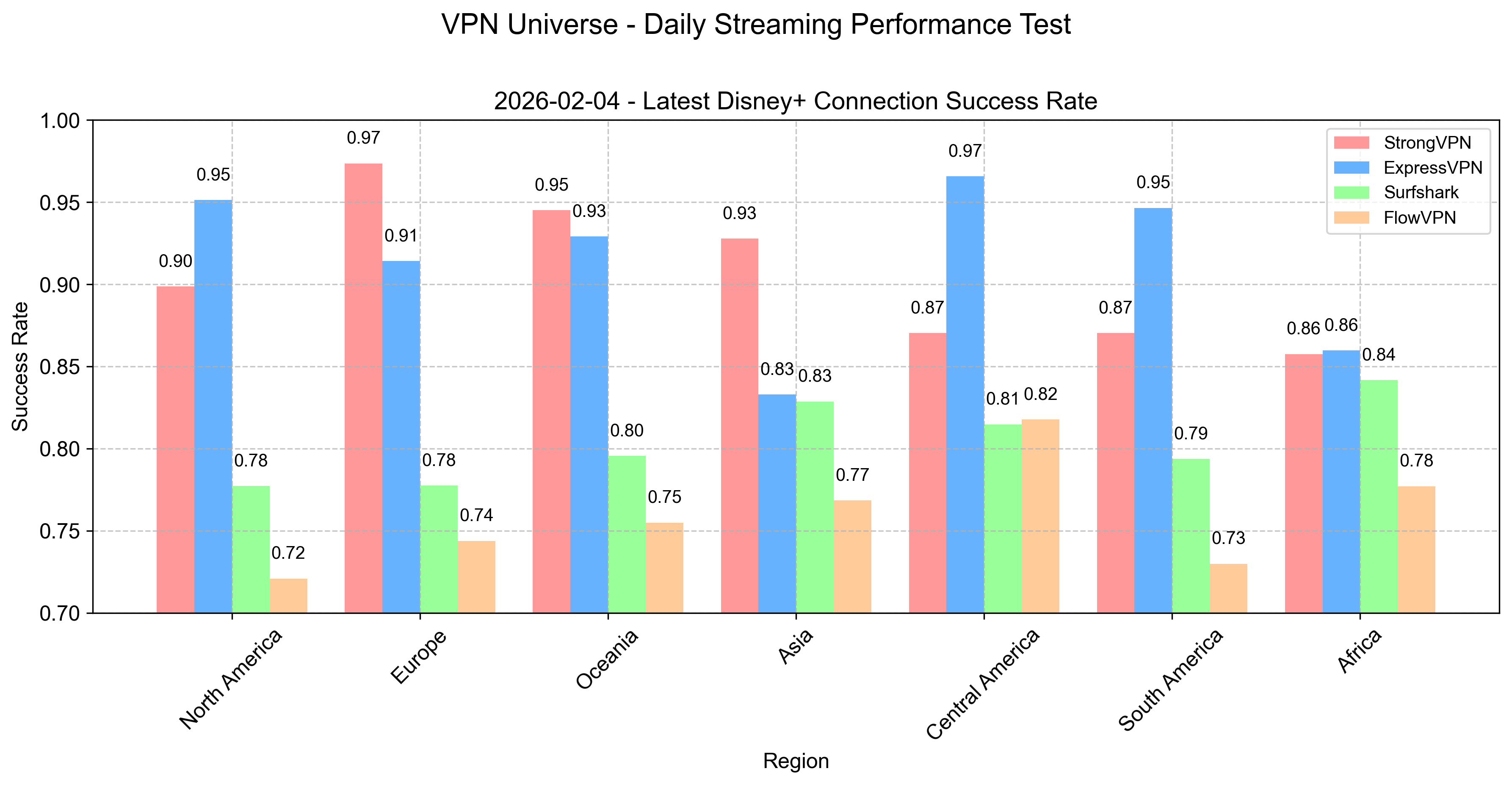
Netflix and Disney+ Connection Checks
Streaming platforms can block VPN IPs, rotate restrictions, or show different libraries depending on region. These charts are generated from the VPN Universe automation and should be read as practical connection checks, not a permanent guarantee that any one server will always work.
Netflix Connection Success
Disney+ Connection Success
Streaming Service Fit
| Streaming Need | What Matters | Recommended Starting Point |
|---|---|---|
| Netflix US / Canada | Fast nearby servers, quick IP rotation, app reliability | ExpressVPN or StrongVPN |
| Disney+ / Hulu bundle | US server quality, stable login sessions, easy server switching | StrongVPN for value testing; ExpressVPN for premium stability |
| Family streaming devices | Multiple simultaneous devices, simple apps, predictable pricing | Surfshark |
| Test before buying | Short trial, quick setup, no long commitment | FlowVPN |
| Public Wi-Fi streaming | Encryption, kill switch, stable apps | StrongVPN or ExpressVPN |
How to Choose a VPN for Streaming
1. Start With App Quality
For streaming, app quality matters more than a theoretical server count. A VPN that connects quickly, switches servers cleanly, and works on Fire TV, Apple TV, routers, Windows, macOS, iOS, and Android is easier to use than a faster VPN that constantly needs manual fixes.
2. Prefer Paid VPNs Over Free VPNs
Free VPNs are usually poor streaming tools. They tend to have small server pools, overloaded IPs, data caps, slow speeds, and IP addresses already blocked by major platforms. If you only need a one-time test, a free tool may be enough. For regular Netflix, Disney+, Hulu, Max, Prime Video, or sports streaming, paid VPNs are normally the practical choice.
3. Use Nearby Servers First
For US and Canada streaming, start with a nearby US or Canadian server before trying distant regions. Nearby servers usually reduce latency and buffering. If a streaming app blocks one server, switch to another nearby location before changing countries.
4. Check Router and TV Support
Many streaming problems happen because the VPN works on a laptop but not on a smart TV. If you watch on Apple TV, Fire TV, Roku, Chromecast, game consoles, or a router, check app and setup support before buying.
5. Check Refund Terms Before Testing
Streaming access changes. A VPN can work today and need a different server tomorrow. For that reason, refund policy and trial options matter. Test your actual devices, your own streaming accounts, and your target services during the refund window.
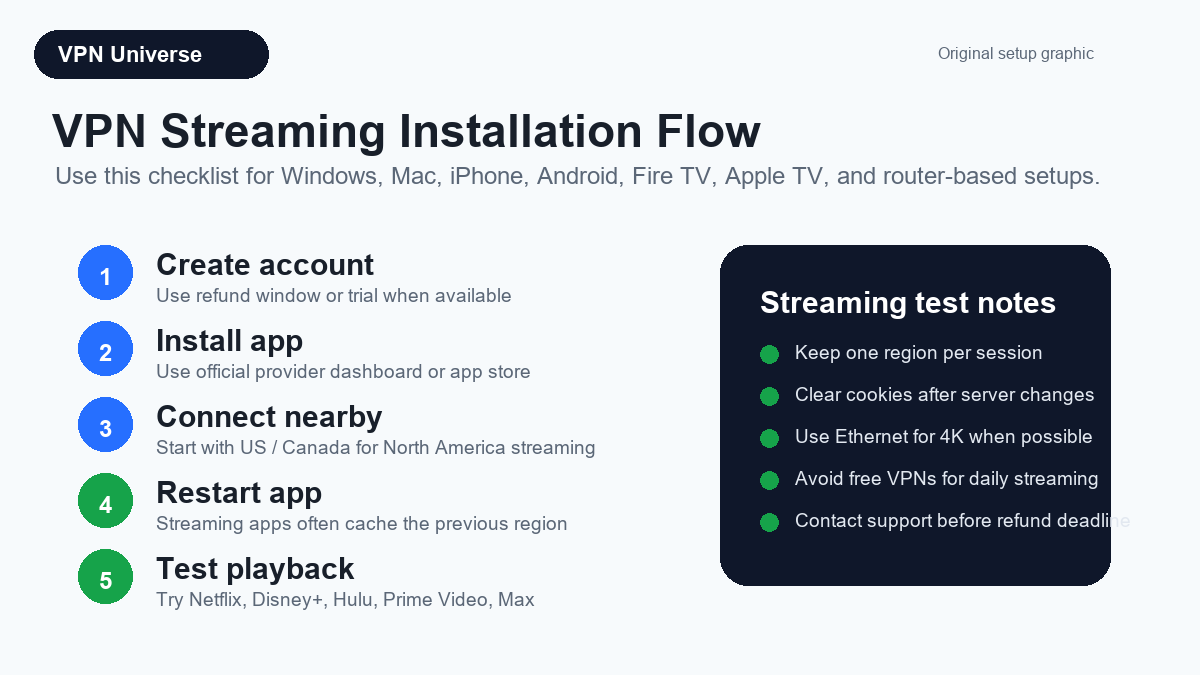
Recommended Streaming Setup
- Pick a VPN with a refund policy or trial.
- Install the app on your main streaming device.
- Connect to a nearby US or Canada server.
- Test Netflix, Disney+, Hulu, Max, Prime Video, or your target service.
- If blocked, switch to another server in the same region.
- If the VPN still fails, contact support or use the refund window.
Refund-Window Streaming Test Plan
Competitor rankings are useful, but streaming VPN performance changes often. Treat the refund window as your own hands-on test period.
| Test | What Good Looks Like | Red Flag |
|---|---|---|
| Netflix / Disney+ / Hulu login | App opens normally and shows the expected catalog | Proxy warning, endless loading, or wrong region after reconnecting |
| 4K or HD playback | Video starts quickly and stays stable for 20-30 minutes | Buffering after every server change |
| TV device support | Fire TV, Apple TV, router, or Smart DNS setup is documented and usable | Works on laptop only, but not on your TV setup |
| Public Wi-Fi | App connects at hotel, airport, school, or cafe Wi-Fi | Captive portal or DNS issues break the VPN repeatedly |
| Support chat | Support suggests specific servers/protocols for your app | Generic answers with no streaming-specific help |
| Renewal price | You understand the first-term and renewal cost | Cheap first term but unclear renewal pricing |
Sports and Live Event Streaming Notes
For US and Canada users, live sports can be harder than normal on-demand streaming because apps often check location, billing region, blackout rules, and device data at the same time. This matters for ESPN+, YouTube TV, regional sports networks, NHL/NBA/MLB/NFL apps, and major international events such as the 2026 World Cup.
Use this order when testing sports streams:
- Pick one target service and one target region.
- Use a nearby server first instead of jumping across countries.
- Avoid switching locations mid-game.
- Test before the event starts, not at kickoff.
- Keep the service rules in mind; VPNs can improve privacy and travel access, but they do not override platform terms.
Installation Guides by Device
Windows or Mac
- Choose a VPN and create an account.
- Download the official desktop app from the provider dashboard.
- Sign in and choose a nearby US or Canada server.
- Open Netflix, Disney+, Hulu, Prime Video, Max, or YouTube TV in a fresh browser window.
- If the service detects the VPN, clear cookies or switch to another nearby server.
Recommended starting links: ExpressVPN, StrongVPN, Surfshark.
iPhone or Android
- Install the VPN app from the official app store.
- Log in and connect to a nearby streaming region.
- Force close the streaming app, then reopen it after the VPN is connected.
- If the app still shows the wrong region, clear app cache or reinstall the streaming app.
This setup is useful for hotel Wi-Fi, airports, public Wi-Fi, and travel streaming.
Fire TV or Fire Stick
- Search for the VPN app in the Amazon Appstore.
- Install, sign in, and connect before opening the streaming app.
- If streaming fails, restart the Fire TV device and try another server.
- If the VPN app is not available, use router VPN setup instead.
Fire TV is one of the most practical streaming VPN devices because many major VPNs support native apps.
Apple TV
- Check whether your VPN provides a native tvOS app.
- If a native app is available, install it from the App Store and connect before streaming.
- If not, use router VPN setup or Smart DNS if the provider supports it.
- Test Netflix, Disney+, Hulu, and Prime Video separately because each platform can behave differently.
Apple TV setup is more provider-dependent than desktop or mobile setup. Verify compatibility before committing to a long plan.
Router, Roku, Chromecast, and Game Consoles
- Use a VPN-compatible router or travel router.
- Install the VPN profile or app at router level.
- Connect Roku, Chromecast, PlayStation, Xbox, or smart TV to that router network.
- Test one streaming service at a time and avoid switching countries repeatedly in the same session.
Router setup is useful when your device cannot install VPN apps directly, but it is more technical and can reduce speed if the router hardware is weak.
Troubleshooting Streaming VPN Blocks
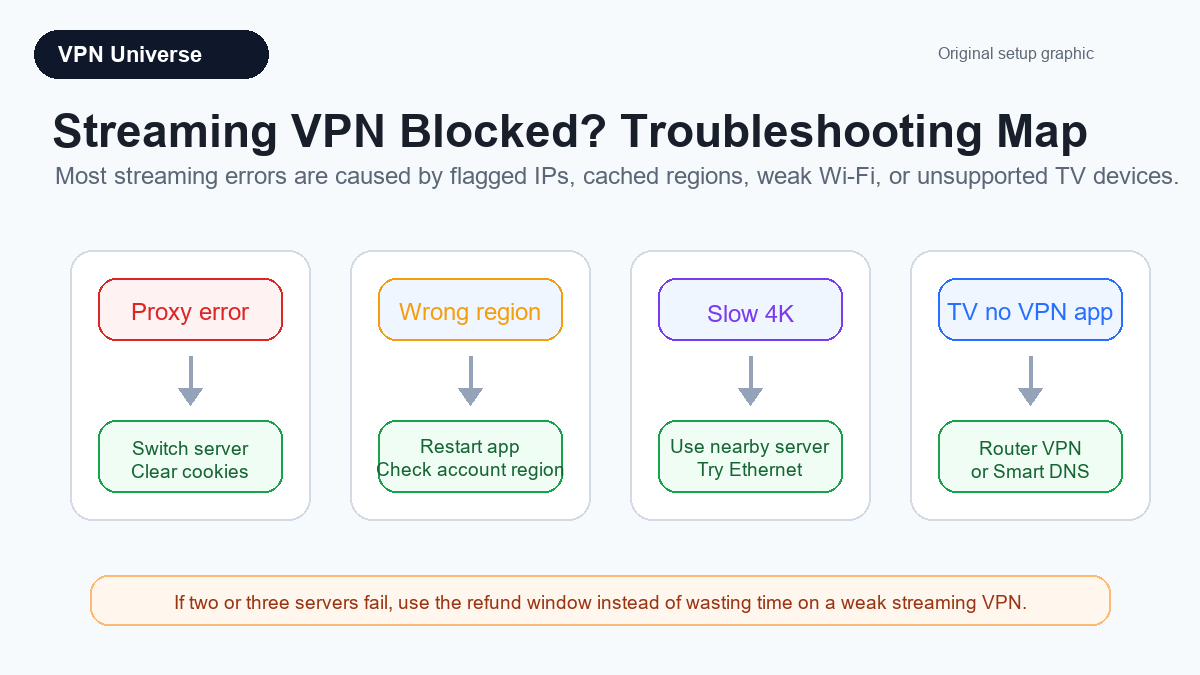
| Problem | Likely Cause | Fix |
|---|---|---|
| Netflix says you are using a proxy | The VPN IP is flagged | Switch servers, clear cookies, restart browser/app |
| Disney+ logs in but video will not play | Region or cached app data mismatch | Change server, clear app cache, test browser and app separately |
| Hulu says location is unavailable | Hulu expects a US location | Use US servers only and avoid mobile GPS mismatch |
| Slow 4K playback | Server congestion, Wi-Fi issue, weak router | Try WireGuard/Lightway if available, move closer to router, use Ethernet |
| Smart TV has no VPN app | Device does not support VPN apps | Use router VPN or Smart DNS |
| Works on phone but not TV | TV app has cached region or uses different DNS | Restart TV, clear app data, test router setup |
FAQ
What is the best VPN for streaming in 2026?
For premium stability, start with ExpressVPN. For value, start with StrongVPN. For multiple devices, Surfshark is often the more practical household option.
Can a VPN guarantee Netflix or Disney+ access?
No. Streaming platforms can block VPN servers at any time. A good VPN improves your odds by maintaining more servers, refreshing IPs, and offering support, but no VPN should be treated as a permanent guarantee for every service.
Is a VPN legal for streaming?
In the US and Canada, using a VPN is generally legal. However, streaming platforms may restrict VPN use in their terms or block VPN IPs for licensing reasons. Use a VPN responsibly and follow the service rules where applicable.
Is this page for China VPN users?
No. VPN Universe is primarily a North America and global VPN comparison site. This streaming page is written for users who care about streaming access, public Wi-Fi privacy, household devices, and everyday VPN reliability.
Bottom Line
If streaming is your priority, choose based on stability, app quality, device support, and refund flexibility. Start with ExpressVPN for premium reliability, StrongVPN for value, Surfshark for multiple devices, or FlowVPN if you want a short test before buying.
Return to the main VPN Universe daily VPN comparison.